
'Macro headwinds are rising for Indian equities in the form of rising commodity prices, especially oil, depreciating rupee, fiscal challenges, election-related uncertainty and upside risks to inflation'

Stock markets in structural bull run but there can be bouts of volatility says Ravi Gopalakrishnan, head, equities, Canara Robeco Mutual Fund

'The fiscal deficit target of 3.9 per cent of GDP seems achievable.'

'Indians are great savers, but they are lousy investors.'

The economy is projected to clock 7.4 per cent growth.

Volatility is part and parcel of stock market.

Oil prices have already fallen over 70 per cent since the downturn began in mid-2014.

'GIFT City is now on a growth trajectory,' says Tapan Ray, MD and group CEO, GIFT City, 'The time has come for the GIFT City to take the big leap and emerge as the next financial hub of Asia.'

'Going ahead, I think the world trade will slow down or decline, and this will be bad for everybody.'

Among Sensex constituents, Vedanta fell 3.40 per cent, followed by SBI 3.17 per cent, Yes Bank 3.11 per cent, Axis Bank 1.68 per cent, ONGC 1.60 per cent, Power Grid 1.52 per cent and HDFC 1.48 per cent.

For rest of the year, the issue is largely going to be the balance between growth rates and macro stability versus interest rates, says Sankaran Naren.

Encouraged by foreign exchange reserves touching record levels, the Reserve Bank on Tuesday doubled the annual overseas investment ceiling for individuals to $2,50,000.

The implications aren't too significant, given the size of Ukraine and its role in the global economy.

Retail inflation crossed the RBI's comfort level and rose to 5.21 per cent in December on increase in prices of food items.

Economy grew at 7.9 per cent in the fourth quarter of 2015-16 taking the overall GDP growth to a five-year high of 7.6 per cent in the fiscal, mainly on account of good performance of manufacturing sector.
Global events will continue to be in the limelight, besides domestic policy.

The benchmark indices have rallied 28 per cent this year, while the broader market has outperformed

The long-term growth perspective or potential for India is one of the highest in the Asia Pacific region.

China's economy, which suffered 6.8 per cent slump in the first quarter due to the coronavirus pandemic -- the worst in 44 years -- bounced back posting 4.9 per cent growth between July and September buoyed by the government's sweeping efforts to stimulate demand and consumption.
Aptech, Lumax Industries, Vedanta, Indian Bank, Venky's India have appreciated over 200% in a year

Premium valuations era started in 2006 and went hand in hand with decline in the US interest rates

Check out some of the stocks that will react on the basis of their numbers in the near term.

As Nasdaq-listed company indicates poor spending in financial services space, Indian firms feel jittery

On gold buying occasions such as Akshaya Tritiya, Chiraj Mehta points out, investors are often confronted with the question: Should I make just a token purchase, or should I buy more towards building my allocation in the yellow metal?

Global private equity major KKR has ranked India second among the emerging markets on external risks, citing the high fiscal and current account deficits.

With more favourable view on Indian economy and business environment under the Narendra Modi government, the risk premium for Indian papers began to climb down.

TCS kicked-off the Q1FY17 earnings season for information technology companies on Thursday.

The rupee is expected to become more jittery and choppy in the near-term

TCS, Infosys do well but Wipro & HCL disappoint analysts; however, outlook for FY17 bullish in general.

Financials are the top gainers along with index heavyweights.

The strategy of returning cash to shareholders through stock purchases could hinder their digital expansion plans

At least three brokerages, two domestic and one global, have said the company could cut its revenue growth guidance again in dollar terms

Experts say the BSE Sensex could rise to around 32,000 in a year.

It can be noted that the rupee lost nearly 7 per cent since the beginning of May as FIIs have pulled out nearly $4 billion from the domestic debt, as bond yields fell on expectation of RBI cutting rates on Monday.

The 50-stock NSE barometer Nifty finished 22.50 points, or 0.21 per cent, down at 10,526.20

With the frontline Indian benchmark indices trading near all-time highs ahead of the general elections that begin later this week, Marc Faber, Editor and Publisher of "The Gloom, Boom & Doom Report" tells Puneet Wadhwa that the Indian stock market is relatively expensive, especially the index (large-cap) stocks.
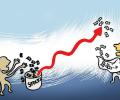
Small stocks made a dashing comeback in 2020 after delivering negative returns in the last two years as increased retail investor participation in pandemic times saw small-cap index surging up to 31 per cent and outperforming the bigger benchmark gauge. This year turned out to be eventful for the equity market, witnessing bearish and bullish sentiments at different points of time. While the initial part of COVID-ravaged 2020 saw the bears in full force amid concerns related to the pandemic and lockdowns hurting economic activities, bulls made a comeback towards the latter half of the year. As the market swayed with many lows as well as highs, small and mid-cap indices emerged as markets favourites in 2020.

Overall market benchmark Sensex is headed for its worst performance in four years with a decline of 1,650 points

Nobutaka Kitajima, chief investment officer -- equity, LIC Nomura Mutual Fund, tells Business Standard the reaction to the Fed's statements has been overdone and the current downturn has punished certain stocks much more than their inherent economic worth and business potential.

"While the risk of a correction goes up in the near term, on a long-term basis the Indian market is on an absolutely strong footing."
